95% of enterprise AI pilots fail — and most of them fail at the question stage. Why "which vendor?" is the wrong starting point, and what to ask instead.
Why the most expensive mistake in enterprise AI is happening at the question level — not the execution level.
If your AI roadmap starts with "which vendor?", you may already be asking the wrong question.
There's a meeting happening in nearly every Fortune 500 boardroom this quarter. A leadership team sits down to plan their AI roadmap. Within the first ten minutes, someone asks the question that feels like the right one:
"So — which vendor?"
That's the moment the strategy fails.
Not because the vendors are bad. Anthropic, OpenAI, Palantir, Google, Microsoft — these are extraordinary companies with extraordinary engineers. The failure isn't downstream in execution. The failure is upstream in the question itself.
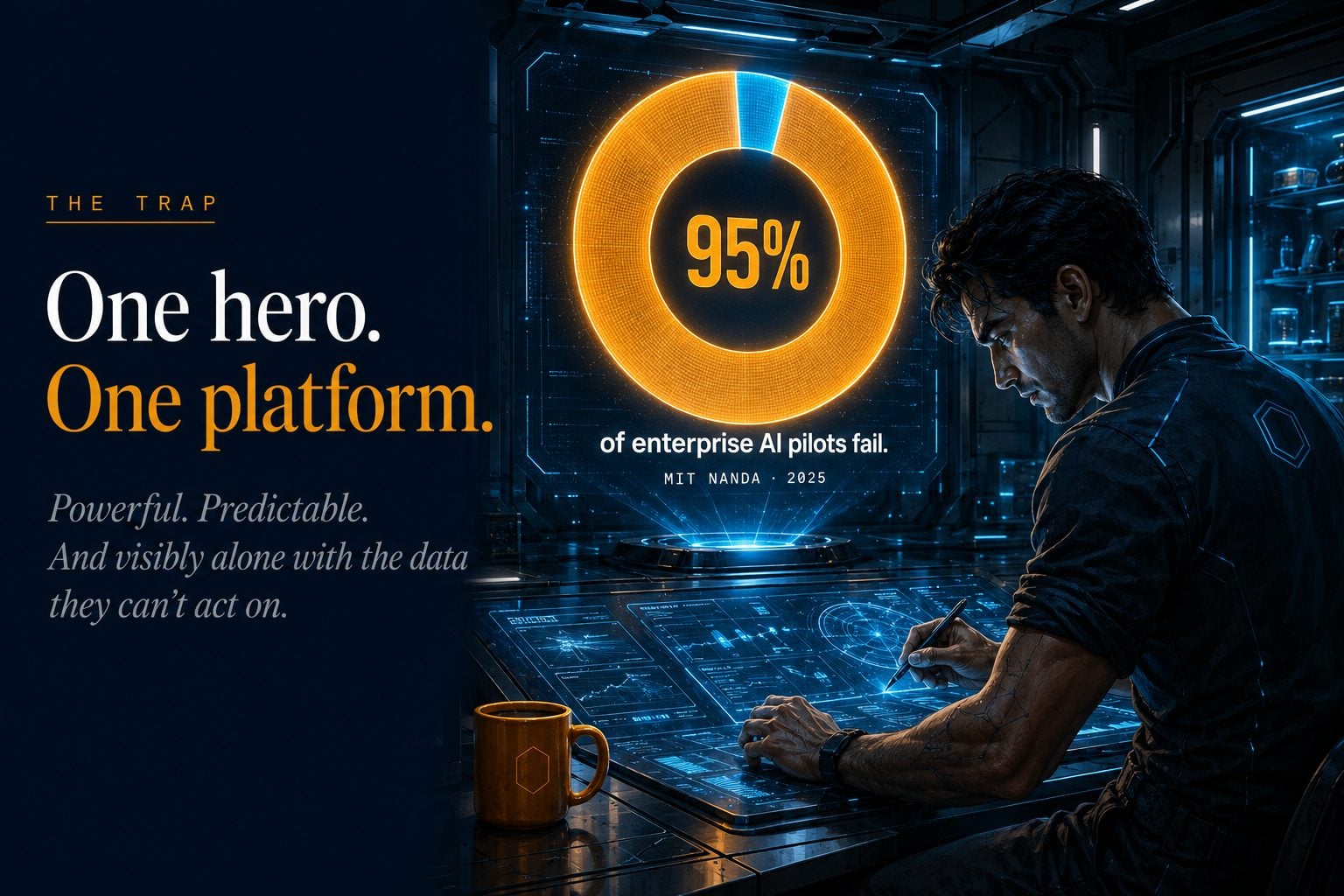
According to MIT NANDA's State of AI in Business 2025, 95% of enterprise AI pilots show no measurable business impact (MIT NANDA, 2025). Gartner forecasts that over 40% of agentic AI projects will be cancelled by end of 2027 (Gartner, 2025). S&P Global Market Intelligence found that the average organisation scraps 46% of AI proof-of-concepts before they reach production (S&P Global, 2025).
Most of those failures didn't happen at the model layer. They happened at the question layer.
The trap is the question itself
When the first question is "which vendor?", three things happen automatically — and quietly.
The architecture becomes the vendor's roadmap. Whichever platform you pick first defines what's possible. Your agents inherit their orchestration framework. Your data flows through their abstractions. Your governance evidence accumulates inside their auditing tools. Six months in, you're not running an AI strategy. You're running a single vendor's product preview.
The problem definition gets bent to fit the tool. Forward Deployed Engineers from any vendor are brilliant at making their platform shine. But the problem you actually need to solve may not be shaped like their best demo. "What can we build with Claude?" is a fundamentally different question from "what's the highest-leverage workflow to automate in our claims department?" — and the answer to the second question rarely produces a single-platform shopping list.
The optionality vanishes silently. Zapier's 2026 enterprise AI survey found that 81% of enterprise leaders are concerned about AI vendor dependency — yet only 6% believe they could switch their primary AI provider without material operational disruption (Zapier, 2026). Forty-seven percent say a key business function would stop working if their primary AI vendor had a significant outage or pricing change. The lock-in didn't happen on signing day. It accumulated week by week, integration by integration, until the door quietly closed.
The Builder.ai collapse in 2025 made the cost concrete. A Microsoft-backed company valued at $1.3 billion shut down operations and left enterprise customers stranded. NexGen Manufacturing — one of the affected firms — spent $315,000 migrating 40 AI workflows to a new platform, with three months of engineering time consumed and several customer-facing features degraded during the cutover (Swfte AI, 2026).
That's the price tag of a question asked in the wrong order.
The industry has already moved on. Most enterprises haven't.
Three signals in 2026 say the single-vendor era is ending, even as vendors race to write its final chapter.
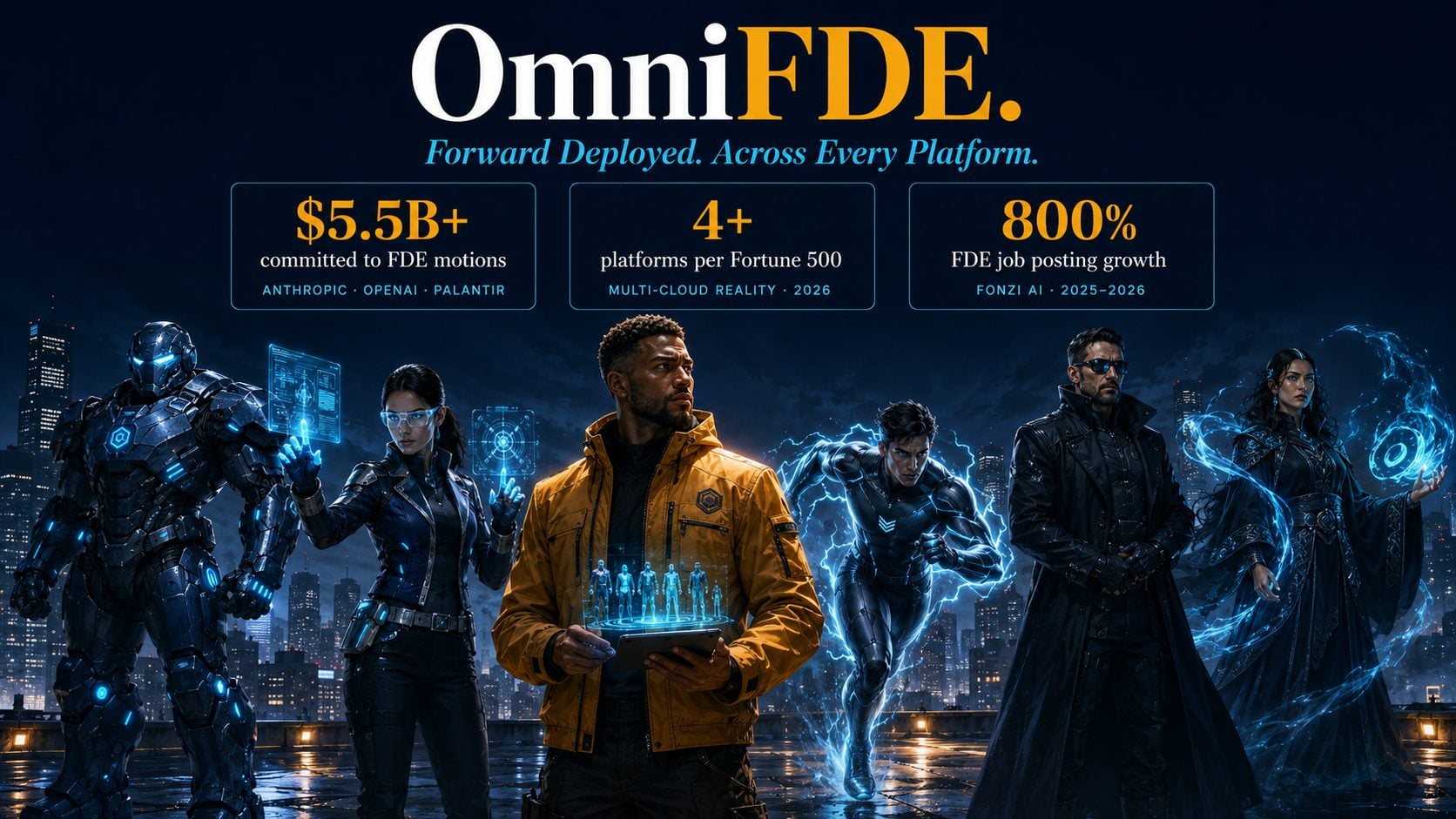
Signal one — the four-platform median. Fortune 500 AI estates in 2026 now run an average of four-plus platforms simultaneously. Anthropic for reasoning workloads. OpenAI for chat and tooling. Microsoft for productivity-embedded AI. A workflow automation layer (UiPath, Power Automate, n8n) tying it together. Ninety-three percent of enterprises now operate in multi-cloud environments (Swfte AI, 2026). The single-vendor commitment is becoming structurally difficult to justify in any boardroom that has read its own architecture diagram lately.
Signal two — vendors building for interop. Anthropic shipped the Model Context Protocol (MCP) to let agents talk across platforms. OpenAI launched the Agents SDK with the same openness in mind. Google opened Vertex AI to non-Google models including Anthropic, Meta, and Mistral. As Kai Waehner observed in April 2026, "the choice of foundation model vendor and the choice of agent framework are not independent decisions" — and the vendors themselves are acknowledging the multi-platform reality their best customers are already living (Kai Waehner, 2026).
Signal three — the talent layer is multi-native. Talk to any senior AI engineer in 2026: most have shipped production work across Anthropic, OpenAI, Azure, and at least one open-source model in the past year. Single-stack loyalty is a 2023 trait. The next generation of AI engineers isn't loyal to one platform — they're loyal to the problem.
Meanwhile, every major AI vendor is committing billions to embedded engineering practices. Anthropic announced a $1.5 billion enterprise joint venture in May 2026 with Blackstone, H&F and Goldman. OpenAI launched a $4 billion Deployment Company that same month with Bain, Capgemini, McKinsey and Brookfield. Palantir's stock returned over 640% across five years, largely on the strength of its Forward Deployed Engineering motion. Accenture partnered with Microsoft to formalise an FDE practice in March 2026. The vendors aren't subtle about it. More than $5.5 billion has been committed to Forward Deployed Engineering motions in the last fourteen months alone (Anthropic, 2026; OpenAI, 2026; Palantir financial reporting).
That's the urgency. The vendors are racing to embed their engineers inside your organisation. And each one of those engineers knows exactly one car.
A Ferrari engineer reads a Ferrari like sheet music. Put them on a McLaren — the telemetry is just noise.
This is the part of the problem that doesn't get said out loud at vendor briefings.
A vendor FDE — by economic gravity, not by intent — is paid to grow their platform's revenue. Their services exist to subsidise license ARR. They're brilliant engineers, but they read one chassis. Put a Ferrari engineer on a McLaren and the telemetry is just noise.
Your enterprise AI estate is not a single car. It's a paddock. Four chassis, sometimes five, running side by side. Each one needs an engineer who can read its telemetry. And you need someone walking calmly between the bays, fluent in all of them, biased only by your problem.
That's the reframe. And it has a name.
The right question, and what it produces
OmniFDE — Omni-Platform Forward Deployed Engineering — is the vendor-neutral evolution of the FDE model. Same embedded build-with-you discipline as any vendor's best engineer. Different relationship with the platform.
The OmniFDE engineer starts with the problem. The platform follows. The problem picks the platform — always.
That single sentence changes the procurement conversation, the architecture conversation, and the budget conversation. "Which vendor?" is replaced with "what is the highest-leverage workflow we should solve, and which combination of platforms ships it fastest, safest, cheapest?"
The answer is rarely one vendor. It's usually three.
Why OmniFDE wins — six benefits the vendor pitch doesn't list
Optionality, by structural design. Your architecture isn't tied to one platform's roadmap. When pricing shifts, when models improve, when a vendor outage hits — and they hit; the June 2025 OpenAI outage paralysed thousands of enterprises with no fallback (AI Assembly Lines, 2026) — you have routing options. Real ones.
Architecture-first thinking. OmniFDE engagements lead with the system, not the SaaS. The output is a deployment that survives the next vendor consolidation, the next acquisition, the next pricing change. Compound lock-in is prevented at the design stage, not the migration stage.
Faster shipping, paradoxically. Multi-platform sounds slower than single-platform. In practice it's faster — because the right tool is used for the right job at every layer instead of every problem being bent toward one platform's strengths.
Internal capability that compounds. OmniFDE engagements train your engineering team across the platforms they actually use, not just one. After ninety days, your team can extend, modify, and operate the system without external help. The next problem doesn't need another consultant.
No consulting-dependency trap. RAND's 2024 analysis named "the consulting dependency trap — where strategy separates from implementation and capability exits with the consultant" — as a significant contributor to enterprise AI failure rates (RAND, 2024). The OmniFDE model is structured to make itself replaceable. That's the deliverable, not a bug.
Transparent cost economics. No vendor quotas to hit. No renewal incentive to bias the recommendation. The architecture is sized for the problem, not for the next sales target.
How to start — the ninety-day adoption path
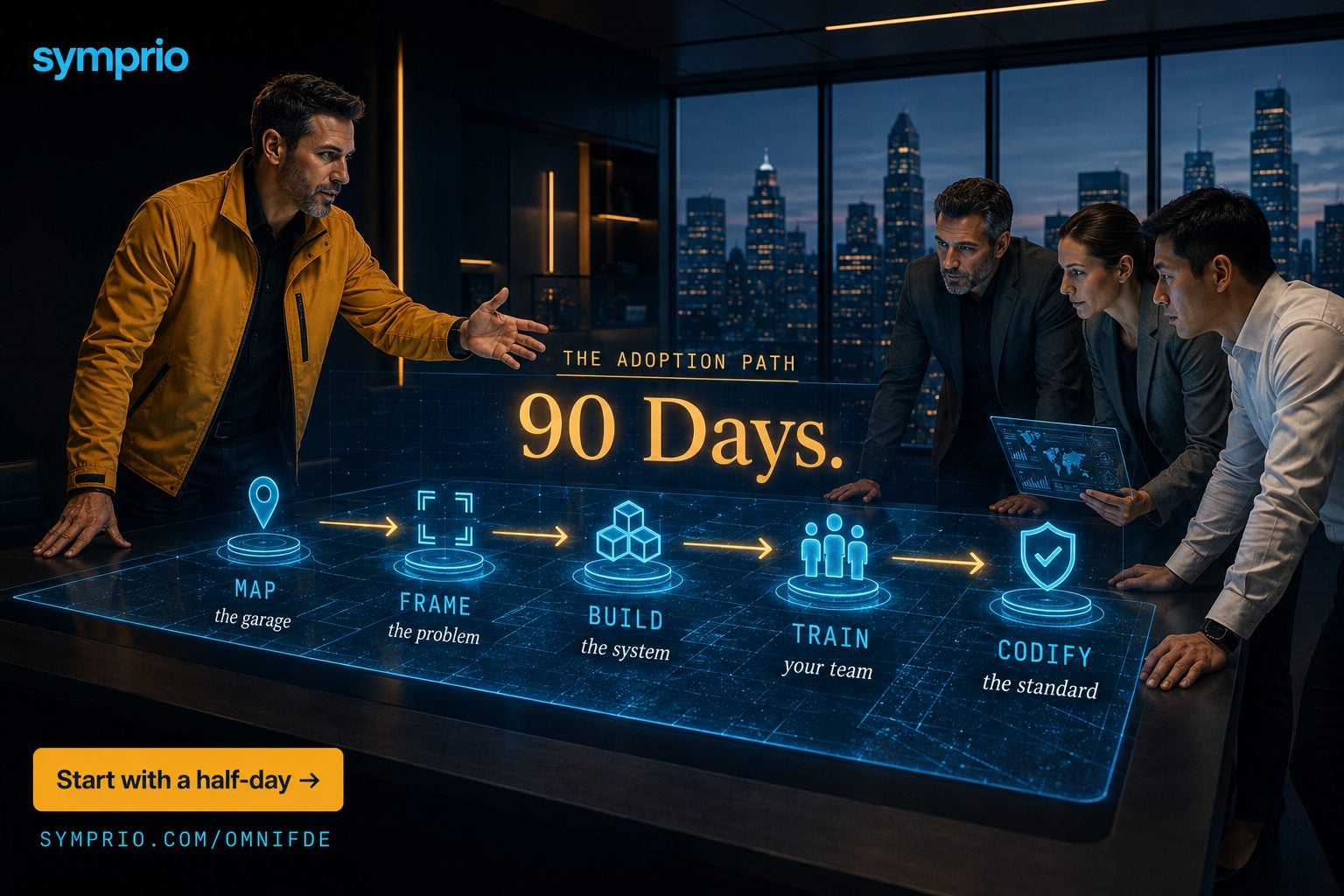
The OmniFDE engagement model is deliberately compact. Five steps. Ninety days. Embedded inside your team.
MAP the garage. Two to four embedded engineers spend the first weeks documenting every AI platform you already own, every contract, every license, every shadow-IT integration. The map is rarely what leadership thinks it is.
FRAME the problem. Before any platform is named, the problem is defined in pure business terms — workflow, value, friction, decision points. This is the step most engagements skip, and most enterprises pay for downstream.
BUILD the system. Production-grade software, not slides. The engineering team architects across the platforms you already own, picking the right tool at each layer.
TRAIN your engineers. Knowledge transfer is structured, weekly, hands-on. By week ten your team is leading the build, with the OmniFDE engineers shadowing rather than driving.
CODIFY the standard. The methodology, the architectural decisions, the platform-evaluation criteria — all documented so the next problem doesn't start from "which vendor?". It starts from the standard.
At the end of ninety days, you have working AI in production, integrated across the platforms you already own, plus an internal team that can extend it. That's the deliverable.
Why Symprio holds this position credibly
Three structural reasons.
We don't sell licenses. Symprio doesn't carry vendor quotas. We don't have renewal incentives that bias the recommendation. We sell outcomes, not platforms. That single structural fact is what lets us hold a vendor-neutral position with a straight face. Most consulting firms can't — their economics depend on the platforms they recommend.
We carry the full stack. Our engineering team holds active production experience across Anthropic, OpenAI, Microsoft Azure, Google Vertex, UiPath, Oracle, and open-source agentic frameworks. We can architect on any of them — and we have. The cross-platform fluency isn't marketing; it's the daily craft of the team.
Big 4 grounding, builder energy. Symprio's senior engineers carry Big 4 advisory backgrounds — the discipline of governance, audit, and enterprise-grade risk management. But we ship working software, not slides. The mix is what enterprise AI delivery needs in 2026: rigour in the architecture, builder energy in the execution.
Symprio sits headquartered in Kuala Lumpur with active engagements across ASEAN and a growing roster of global Fortune 500 work. We're regulated, certified, and structurally positioned to hold the vendor-neutral middle that no major SI or Big 4 firm can credibly occupy.
Where this conversation should start
Not in a procurement meeting. Not at a vendor briefing.
It should start with a half-day with your team. We map your AI estate. We surface the one problem worth solving first. You decide what to do next.
No slide deck. Just whiteboard thinking.
→ Book your OmniFDE discovery workshop Half-day. Complimentary. Whiteboard-only.
If you'd rather read further first, the full OmniFDE briefing is here. The 90-day engagement details, sample architectures, and case work are documented end-to-end.
The question your AI roadmap should start with is not "which vendor?". It's "what's the problem worth solving?".
The problem picks the platform. Always.
Sources & further reading
MIT NANDA, State of AI in Business 2025 — 95% pilot failure data
Gartner forecast, 2025 — 40%+ agentic AI projects cancellation by 2027
S&P Global Market Intelligence, AI in Production Survey, 2025 — 46% scrap rate
Zapier, Enterprise AI Survey 2026 — 81% vendor dependency concern; 6% switching capability
Swfte AI, Breaking Free: How Enterprises Are Escaping AI Vendor Lock-in in 2026
Kai Waehner, Enterprise Agentic AI Landscape 2026: Trust, Flexibility, and Vendor Lock-in, April 2026
RAND Corporation, Enterprise AI Project Failure Analysis, 2024
Anthropic, $1.5B enterprise joint venture announcement, May 2026
OpenAI Deployment Company, $4B launch announcement, May 2026
Palantir Investor Relations — five-year performance and FDE methodology
Accenture × Microsoft FDE practice formation, March 2026
AI Assembly Lines, How to Avoid AI Vendor Lock-In, May 2026
#OmniFDE #ForwardDeployedEngineer #EnterpriseAI #VendorNeutral #AIArchitecture #AIStrategy #Symprio #AgenticAI #AIVendorLockin #MalaysiaAI #Omni #FDE
Symprio is an enterprise AI delivery practice headquartered in Kuala Lumpur, with engagements across ASEAN and global Fortune 500 clients. We architect and build production AI across every major platform — without selling licenses, without carrying vendor quotas, and without renewal incentives. The problem picks the platform. Always.
Forward Deployed. Across Every Platform.