
How is RPA priced in Malaysia? The four cost components every project is built from, the three hidden traps in most quotations, and how to read a proposal confidently — so you can budget with eyes open.
When Malaysian leaders first evaluate Robotic Process Automation (RPA), the question is usually "how much will it cost?" That is the wrong first question. The better one is "what actually shapes the cost?" — because the total investment depends entirely on your portfolio shape, your platform choice and how you procure. Anyone quoting a hard number before they understand those three things is guessing.
This post walks through the real cost components Malaysian enterprises are paying for when they buy RPA, the traps that inflate those components unnecessarily, and the few questions you can ask any vendor or partner to cut through the proposal noise.
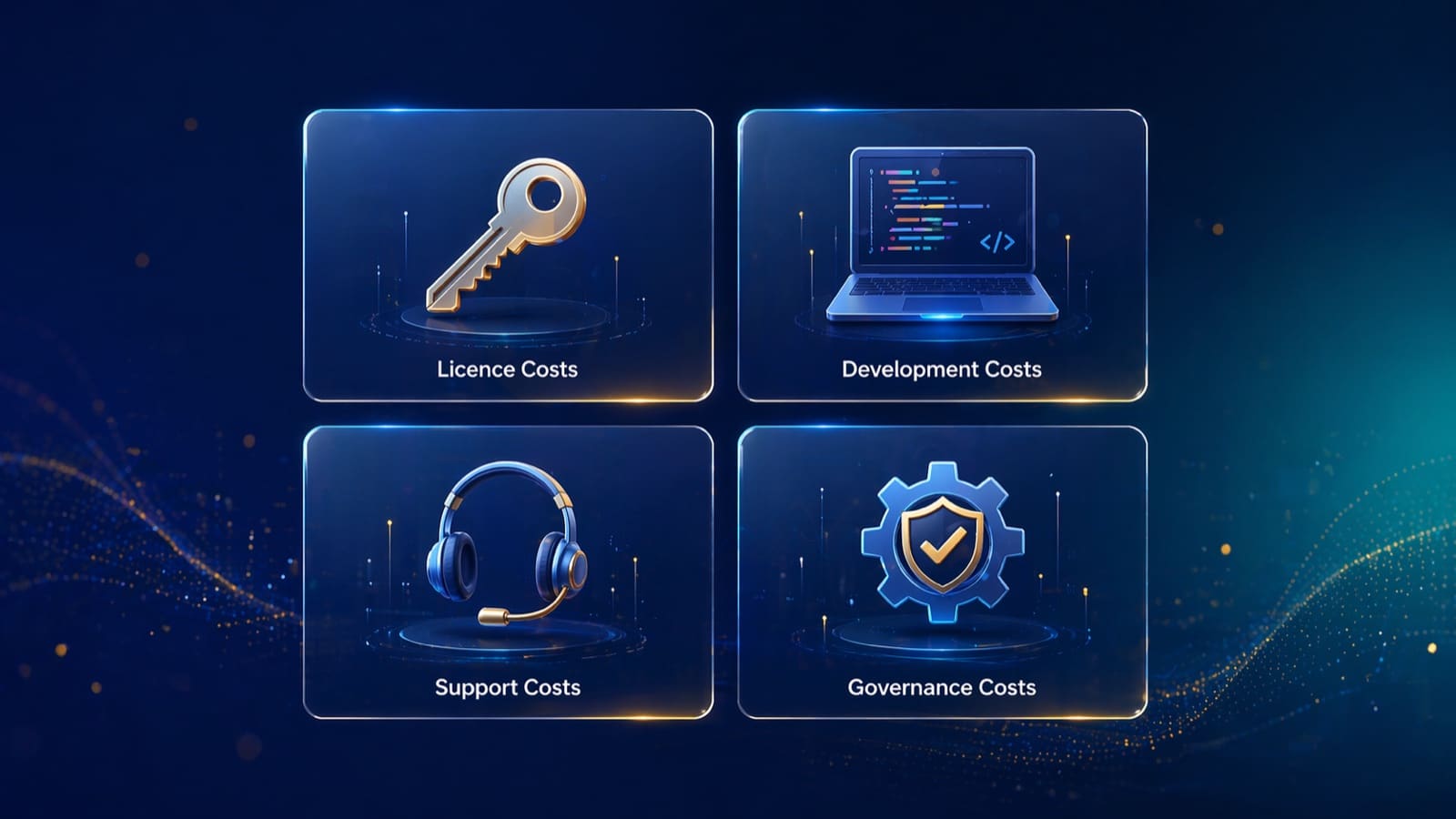
The four components of every RPA investment
Any quote from any vendor or partner breaks down into the same four buckets. The art is not memorising prices — it is understanding what drives each one so you can stress-test a proposal against your own reality.
1. Platform licensing — paid directly to the vendor
This is what you pay UiPath, Microsoft or Automation Anywhere for the right to run bots on their platform. The licensing model varies more than the headline price:
- UiPath is priced by bot tier and optional modules (Document Understanding, AI Center). Great fit for regulated, unattended portfolios.
- Microsoft Power Automate is priced per-user or per-flow. Often the most economical choice for Microsoft-first enterprises where most scenarios are bundled inside existing M365 plans.
- Automation Anywhere is cloud-first with bot-based subscriptions.
A good partner will always recommend you procure licensing directly from the vendor, not through them. If a proposal bundles licensing with development, ask for the two line items separated — you want to see exactly what the vendor is charging you.
2. Implementation — the build itself
The largest and most variable component. Implementation cost is driven by four things, in order of impact:
- Process complexity. A simple invoice-posting bot is not the same as a customer-onboarding bot that spans six systems. More decision branches and more exception paths mean more days.
- Integration count. Each system the bot has to read or write — core banking, SAP, Oracle ERP, local portals like LHDN or Kastam — adds integration and test effort.
- Team seniority. A mid-level developer costs less per day than an architect, but architects build cleaner code that needs less rework. Where you invest seniority matters.
- UAT rigor. The difference between a bot that works in demo and a bot that survives production is testing. Expect a well-scoped proposal to spend more time on UAT than on build.
3. Managed support — the ongoing bucket
Bots are production software. They will break — because the core banking system pushes an update, because a website redesigns, because a document format changes. Support cost is driven by:
- Portfolio size — 3 bots are cheap to watch, 30 are not.
- Availability SLA — a business-hours response is very different to 24/7 critical-incident coverage.
- Change velocity — if your underlying systems change often, budget for more maintenance.
- Criticality — a month-end bot that feeds regulatory reporting needs a different SLA to an internal HR helper.
Treat support as a line item you pay from day one, not something you bolt on later.
4. Governance and Center of Excellence (CoE)
The component most often cut — and most often regretted. CoE covers coding standards, reusable component libraries, deployment pipelines, security controls and citizen-developer enablement. It is a fixed investment that amortises across the portfolio: without it, your third bot costs more than your first because everyone reinvents the wheel.
Three cost traps to watch in Malaysian RPA quotations

Trap 1: "fixed scope" that stops at go-live
Production bots always need a tuning period after launch. If hypercare is a separate line — or missing altogether — the proposal is incomplete, not cheap. Ask: "is hypercare bundled, and for how long?"
Trap 2: a build-heavy, test-light effort split
A well-scoped proposal puts a meaningful share of effort into testing, exception handling and production-hardening. If a proposal's days are 70% build and 30% everything else, the bot will struggle the moment real data hits it.
Trap 3: licence markup on vendor software
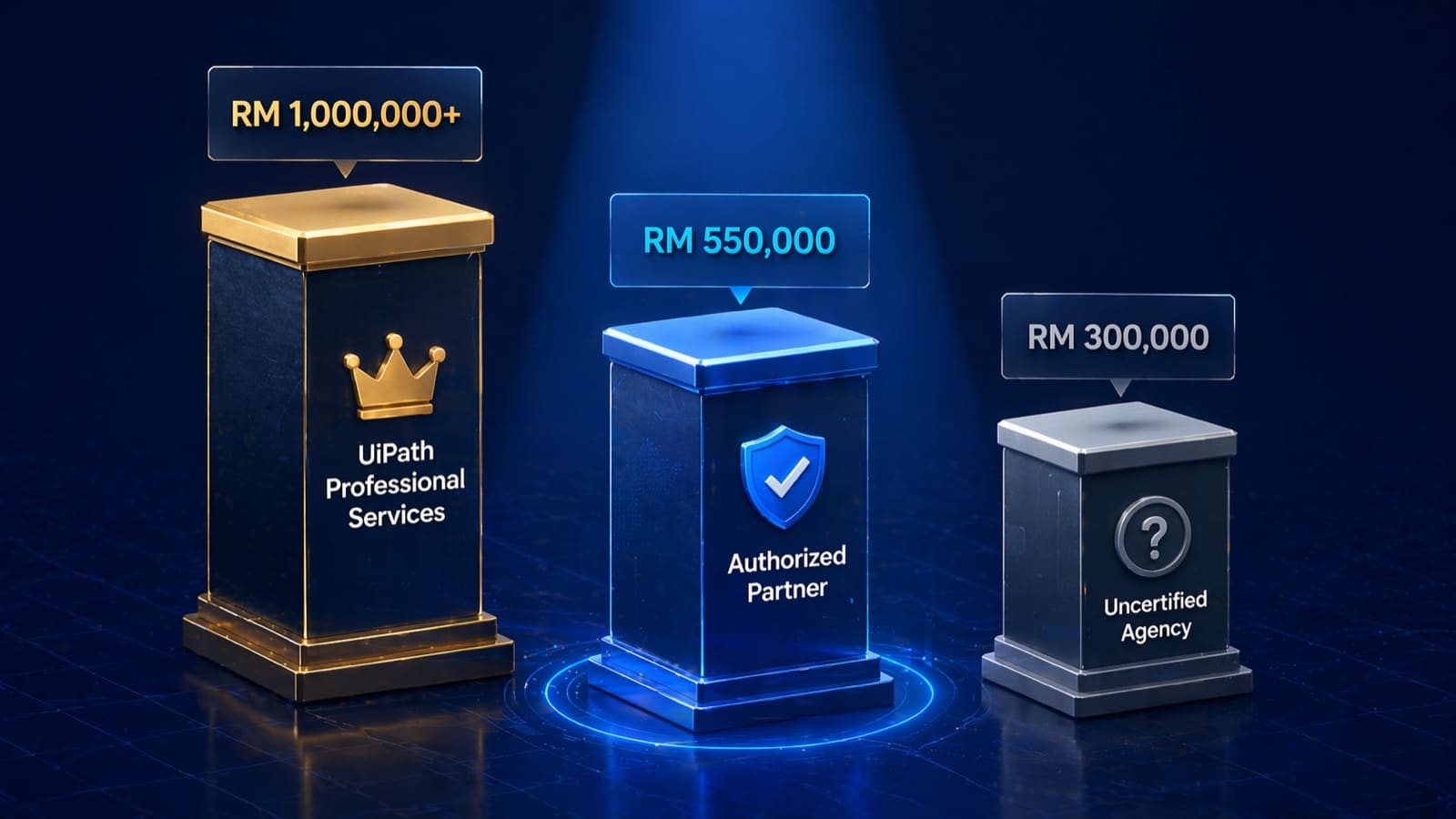
Some uncertified agencies procure licences on your behalf and add a mark-up. Enterprises should always procure licensing directly from the vendor in their own name. A UiPath Authorized Partner will insist on this — it is a tell-tale sign of a real partnership versus a resell play.
How to read an RPA quotation in 60 seconds
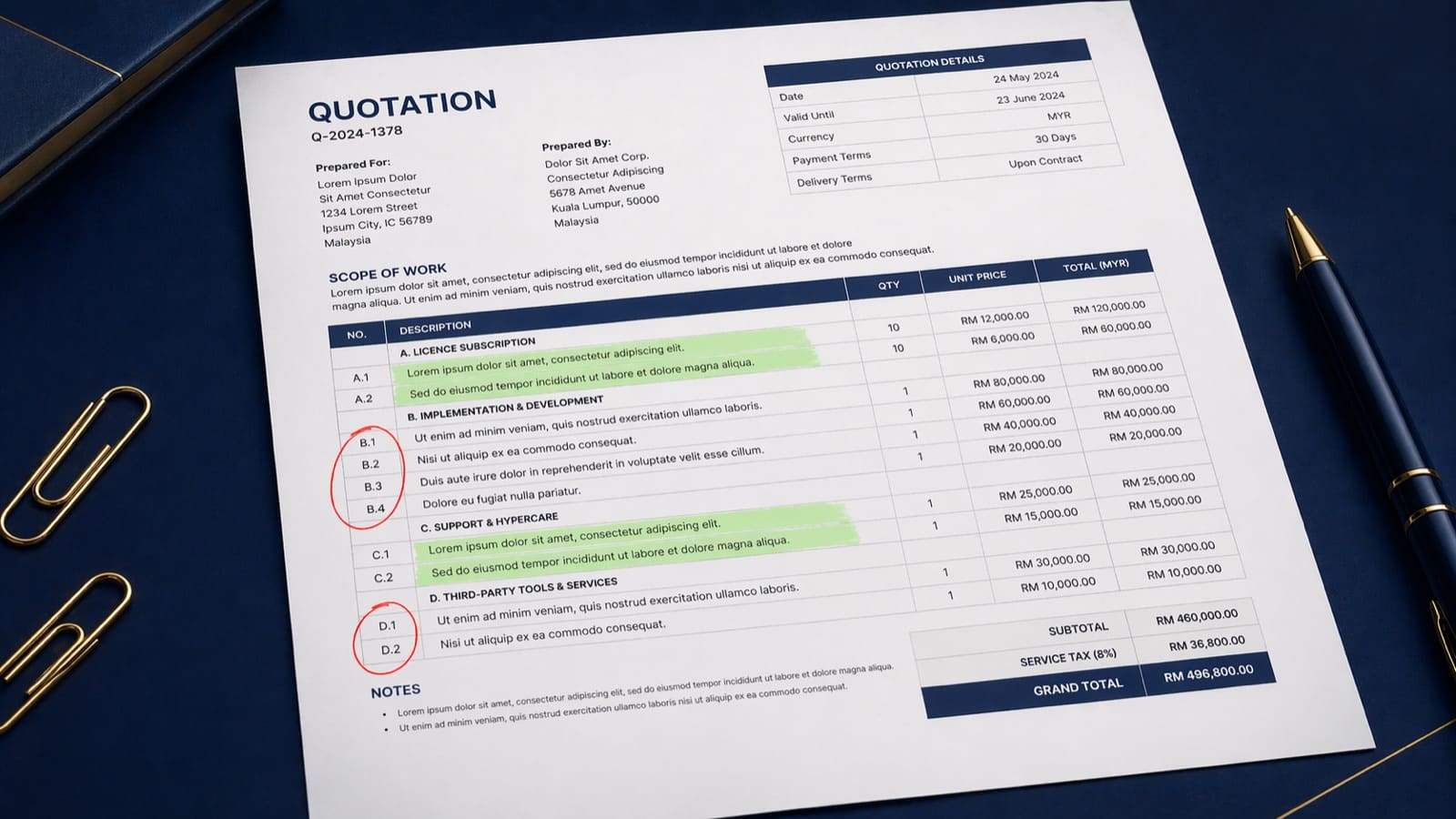
Skip the totals at the bottom and go straight to the assumptions and exclusions sections — that is where the surprises hide. A well-written proposal will be explicit about:
- Scope boundaries. "In scope: invoice processing for vendor types A, B, C. Out of scope: vendor type D (different portal)."
- Environment dependencies. The customer provides sandbox and UAT access by an agreed date.
- Change-request rate card. So you know what future tweaks cost before you agree.
- Hypercare definition. Duration, response times, what it does and does not include.
- Steady-state handover. What the support transition looks like and what you pay for it.
Thinking about ROI, not sticker price
Cost is only half the decision — the other half is the value the automation unlocks. In our experience, good first candidates pay themselves back inside the first year on a fully-loaded basis (licensing, build, support). Processes where payback stretches much longer are usually telling you something: the process may be too complex, too low-volume, or changing too quickly to be a sensible first automation.
Pick candidates where the value is obvious and the business owner is engaged. The numbers follow.
Where to start if you are new to RPA in Malaysia
The highest-leverage first step is a free process assessment. At Symprio we run 2–3 hour workshops with your process owners, shadow the work, and produce a short-list of automation candidates with an honest effort estimate per process. Pilot or not, you leave with a scorecard you can act on.
When you are ready to commit, insist on fixed scope, insist that hypercare is bundled, procure licensing directly from the vendor in your own name, and ensure governance is scoped from day one — not deferred to "when we scale". That is the discipline every successful Malaysian RPA program runs on.
Planning an RPA investment for your Malaysian business? Talk to Symprio — a UiPath Fast Track Authorized Partner and Microsoft Automation in a Day Delivery Partner, delivering from Kuala Lumpur across APAC.