Why enterprises in 2026 must build AI-enabled products — and how vibe coding compresses time to value.
Why enterprises in 2026 must build AI-enabled products — and how vibe coding compresses time to value.
Executive Summary
The defining strategic question for enterprise leaders in 2026 is no longer whether to adopt artificial intelligence. That decision is largely behind us. The question is whether to continue licensing AI as a feature embedded inside someone else's product — or to build proprietary, AI-enabled products of your own.
The data is increasingly clear about which path drives durable value.
80% of organisations now use generative AI in at least one business function.
Only 39% of those organisations can attribute any EBIT impact to AI, and most report less than 5% impact.
A mere 34% of enterprises report using AI to deeply transform their products or processes.
(Sources: McKinsey, The State of AI 2025; Deloitte State of AI in the Enterprise 2026; PwC 2026 Global CEO Survey)
In other words, the enterprise market is saturated with AI pilots, copilots, dashboards, and embedded vendor features — yet starved of AI-enabled products that materially move the P&L. This gap defines the strategic opportunity of the next decade, and it is where Symprio focuses its product engineering practice.
1. The Strategic Shift: From SaaS Subscriber to AI Product Builder

For two decades, the dominant enterprise software playbook has been straightforward: license a CRM, subscribe to an ERP, integrate a help-desk SaaS, and avoid building anything custom. That playbook is now under simultaneous pressure on three fronts.
1.1 The economics of building software have inverted
What once required six months and USD 150,000 with an agency can now be prototyped for USD 29–299 per month using modern AI development platforms. Building software has shifted from a capital expenditure decision to an operating expenditure decision — and in many cases, to a single individual's authority rather than a procurement cycle.
1.2 SaaS moats are eroding in real time
Industry analysts tracking enterprise software in 2026 are explicit about the trajectory. The application software bull case has rested for two decades on switching costs, workflow entrenchment, and the difficulty of building anything custom. (Source: InvestingLive, April 2026) Large language models with agentic coding capabilities are attacking all three pillars at once. The defensibility of incumbent SaaS pricing is materially weaker than current valuations imply.
1.3 Generic AI does not create competitive advantage
McKinsey's most recent strategic framing makes the point directly: as AI adoption spreads, differentiation will stem from how companies build and combine hard-to-replicate competitive moats. (Source: McKinsey, AI productivity gains and the performance paradox, May 2026)
A generic AI chatbot from a horizontal vendor delivers the same capability to your competitor. A custom AI product built on your proprietary data, your workflows, and your domain expertise is the only AI investment that can credibly be called a moat.
2. Why the Window for Action Is Now
The case for moving in 2026, rather than waiting for the technology to "mature," rests on three converging realities.
Market reality. McKinsey reports that 65% of organisations now regularly use generative AI — nearly double the rate from ten months prior. AI agent adoption has reached 40% of enterprise applications in 2026. (Source: Taskade, State of Vibe Coding 2026) The vibe coding market is projected to reach USD 12.3 billion by 2027, with Gartner forecasting that 60% of all new code will be AI-generated by the end of 2026.
Customer reality. Enterprise customers — and even more so retail consumers — now benchmark every digital interaction against conversational AI systems. Applications that do not respond intelligently are experienced as broken. That expectation is the new baseline, not a future trend.
Competitive reality. Enterprise adoption of vibe coding grew 340% from 2024 to early 2026. (Source: DEV Community, April 2026) 82% of developers use or plan to use AI coding tools. 87% of Fortune 500 companies have adopted at least one vibe coding platform. (Source: Second Talent, May 2026) Competitors are not deliberating; they are shipping.
3. The Value Enterprises Capture from AI-Enabled Products

McKinsey's analysis of where AI value actually accrues is unambiguous. Four enterprise outcomes consistently emerge in organisations that move beyond pilots into AI-native product development.
Revenue uplift. Revenue gains from AI are most commonly reported in marketing and sales, strategy and corporate finance, and product and service development. (Source: McKinsey, State of AI 2025) Organisations that set growth and innovation — rather than efficiency alone — as AI objectives capture materially larger impact.
Margin expansion through workflow redesign. Half of AI high performers are using AI to transform their businesses, and most are redesigning workflows. This deliberate workflow redesign is among the strongest predictors of meaningful business impact across the 31 organisational variables McKinsey tested. Incremental AI features layered on legacy processes do not produce comparable results.
Faster, cheaper venture creation. McKinsey reports that 67% of companies which prioritise business building outgrow the market, and each dollar of new-venture revenue creates roughly twice the enterprise value of a dollar from the core business. (Source: McKinsey, AI venture building, March 2026) The time required for new corporate ventures to reach USD 10 million in revenue dropped from 38 months in 2023 to 31 months in 2025 — a trend AI tooling continues to accelerate.
Durable competitive moats. AI products built on proprietary data, workflows, and customer context become the kind of moat traditional SaaS cannot deliver. They are not replicable through a competitor's procurement process.
4. Vibe Coding: The Mechanism That Makes This Economically Viable
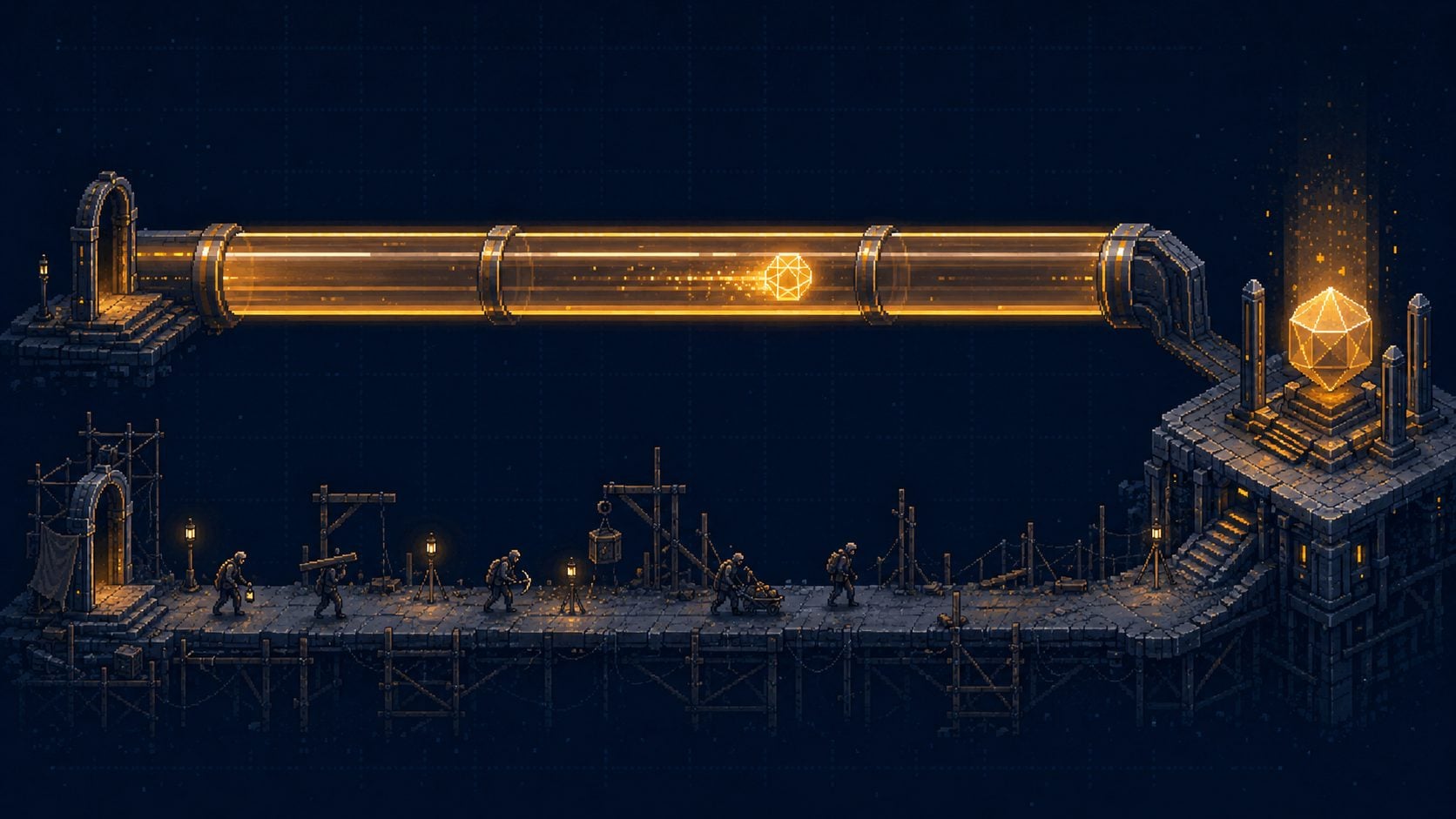
The strategic case for AI-enabled products would remain academic if implementation costs and timelines were unchanged. They are not. Vibe coding — the practice of building software through natural-language instructions to AI agents — has moved from novelty to default mode of software production in less than two years.
The productivity evidence is consistent across sources:
92% of US developers use AI coding tools daily; 82% globally use them at least weekly.
GitHub reports that 46% of all new code is now AI-generated.
Median task completion time drops 20–45% for greenfield features.
IBM reports a 60% reduction in development time for enterprise internal applications using AI-assisted coding.
Microsoft's internal data shows a 40% improvement in sprint completion. Documentation generation responds particularly well, with up to 65% time reduction.
Startups report 2–3x faster MVP development.
(Sources: Hostinger Vibe Coding Statistics 2026; Hashnode, State of Vibe Coding 2026; DEV Community, April 2026)
The practical implications for enterprise planning are summarised below.
Pre-2024 baseline2026 enterprise reality6 months and USD 150K for an MVP2–4 weeks at a fraction of the costSix-person development team to maintainOne or two engineers with AI-augmented workflowsOne product release per yearMultiple AI-enabled products per quarterNew idea = year-long roadmap debateNew idea = working prototype within days
A mid-sized Malaysian enterprise can now reasonably ship three to five AI-enabled internal products in the time it previously took to negotiate a single SaaS contract. This is not a productivity improvement. It is a structural change in what an organisation can become.
5. The Caveat Enterprises Must Take Seriously

Vibe coding excels at the first 90% of a product. The final 10% — production hardening, security, compliance, observability, edge-case handling — remains the most unforgiving part of software engineering. The data is direct:
AI-generated code contains approximately 1.7x more issues than human-written equivalents.
45% of AI-generated code samples fail security benchmarks across OWASP Top-10 categories. (Source: Hostinger Vibe Coding Statistics 2026)
Gartner forecasts that, without proper governance and quality controls, prompt-to-app approaches by citizen developers will increase software defects by 2,500% by 2028.
High-profile failures are documented: Moltbook, an AI-agent application launched in January 2026 with no hand-written code, exposed 1.5 million API authentication tokens within three days of launch through a basic security misconfiguration. (Source: SeedScope, May 2026)
The lesson is not that vibe coding is unsafe; it is that working software is not the same as safe, maintainable, compliant software. In regulated sectors — banking, insurance, healthcare, government — this distinction is the difference between a successful programme and a regulatory incident.
6. The Symprio Approach: Velocity Through Vibe Coding, Depth Through Architecture

Symprio is a product engineering practice as well as an advisory one. We build multi-agent enterprise platforms, configurable SaaS products with administrator-controlled pricing engines, and bespoke AI tools for Malaysian and regional clients — using the same playbook we apply to client engagements. Four principles guide that work.
Vibe coding is treated as a velocity tool, not a substitute for engineering. We deploy the best of Cursor, Claude Code, Lovable, Bolt, and similar platforms where they shine: boilerplate generation, prototyping, scaffolding, and internal tooling. Vibe coding's sweet spot is precisely the work where speed compounds and risk tolerance is highest.
Enterprise-grade architecture wraps every output before it touches production. Where it matters — customer data, regulated workflows, financial logic, agent governance — we apply rigorous software engineering practice: type-safe code, automated testing, observability, audit trails, role-based access control, and explicit human-in-the-loop checkpoints. AIGE-aligned. BNM-ready. PDPA-clean.
We co-build, transfer, and certify. We bring the reference architecture; the client brings the domain. We pair-build the first product alongside the client's engineering team, transfer the patterns, and certify the team to operate the platform long-term. This model preserves the speed of vibe coding while building lasting in-house capability.
The deliverable is a product, not a deck. Every engagement closes with a deployed product, a trained team, and a maintainable codebase. Adopt-and-build is the standard, not a premium tier.
7. What This Looks Like in Practice
Within 90 days of engagement, enterprises typically see deployments such as:
An AI-enabled SME onboarding agent that processes new applications from intake to credit pre-screen in minutes rather than days.
A claims intake co-pilot for general insurance that ingests free-text descriptions, photographs, and policy data, routing routine cases without human handling.
An internal knowledge assistant trained on operations manuals, policies, and SOPs — designed to be used by new employees in place of escalating to senior staff.
An e-invoicing middleware aligned to LHDN MyInvois that resolves the most operationally painful integration with a single configurable, AI-augmented service.
A finance reconciliation agent that closes monthly books up to five days faster, with a full audit trail.
These are not moonshots. Each is a focused, AI-enabled product. Each is achievable in a single quarter. Together they compound into a meaningful and defensible competitive position over twelve to eighteen months.
8. Conclusion
The enterprise software landscape in 2026 is bifurcating.
On one side are organisations that continue to subscribe to generic AI features bolted onto legacy SaaS, hoping that vendor roadmaps will accommodate their reality. On the other are organisations that build proprietary AI-enabled products — tailored to their data, defensible by design, delivered quickly through vibe coding, and made enterprise-grade by disciplined architecture.
Five years from now, these two cohorts will be unrecognisably different. The first will pay rising licence fees for products their best people work around. The second will own products, own data, and own moats.
The strategic question is no longer technical. It is one of organisational intent.
9. Engaging with Symprio

Symprio engages with enterprise clients in three formats:
Discovery workshop (half-day, complimentary). A working session with your senior team to identify the highest-leverage AI-enabled product opportunity in your operating model.
Pilot product engagement (8–12 weeks). Co-build the first AI-enabled product to production, including architecture transfer and team enablement.
Long-term product partnership. Embedded engineering capacity to build a portfolio of AI-enabled products over a 12–24 month horizon.
Sources & Further Reading
McKinsey — AI productivity gains and the performance paradox (May 2026). mckinsey.com
McKinsey — The State of AI in 2025: Agents, innovation, and transformation (November 2025). mckinsey.com
McKinsey — From promise to impact: How companies can measure and realize the full value of AI (April 2026). mckinsey.com
McKinsey — AI venture building: How to scale faster and smarter (March 2026). mckinsey.com
McKinsey — Bridging the great AI agent and ERP divide to unlock value at scale (January 2026). mckinsey.com
Taskade — State of Vibe Coding 2026: Market Size, Adoption & Trends (March 2026). taskade.com
Hostinger — Vibe Coding Statistics 2026: Adoption, productivity, and security data (April 2026). hostinger.com
FindSkill.ai — Vibe Coding in 2026: $4.7B Market, 84% More Apps (April 2026). findskill.ai
Hashnode — The state of vibe coding in 2026: Adoption won, now what? (February 2026). hashnode.com
InvestingLive — The vibe coding revolution is coming for enterprise software quickly (April 2026). investinglive.com
Second Talent — Top Vibe Coding Statistics & Trends 2026 (May 2026). secondtalent.com
DEV Community — Vibe Coding in 2026: $9.2B Cursor, 92% HumanEval (April 2026). dev.to
SeedScope — Vibe Coding Is How Startups Are Being Built in 2026 (May 2026). seedscope.ai
TheNextWeb — McKinsey's new AI report argues the productivity payoff is real but conditional (May 2026). thenextweb.com
© Symprio. Enterprise AI product engineering. Co-built with your team. Owned by you.