
AI benchmarks shape enterprise trust, model selection, procurement, and routing decisions. This post explains how major benchmarks are calculated, what changed in 2025–26, and why Malaysian enterprises must test models on their own real business data.
When a vendor tells you their new model is "state of the art", they are pointing at a benchmark. When a CIO chooses between Claude Opus 4.7, GPT-5.5 and Gemini 3.1 Pro for a regulated workload, the decision rests on benchmarks. When a Malaysian bank validates that an agentic AI deployment is fit for production, the evidence is — again — a benchmark, just one that runs on the bank's own data instead of a public leaderboard.
Benchmarks are the unit of trust in enterprise AI. Yet most leadership conversations treat a benchmark score as a single number, when in reality it is the output of a carefully designed measurement protocol — and the gap between the headline figure and what it actually predicts about your workload is where most procurement decisions go wrong.
This post walks through what the major AI benchmarks actually measure, how their scores are calculated, the new evaluations that reshaped the field in 2025-26, and what every Malaysian enterprise should be measuring on its own data before signing a multi-year AI contract.
Why benchmarks are the foundation of every AI procurement decision
Before we look at specific benchmarks, it is worth being precise about what a benchmark is and what it is not. A benchmark is a fixed dataset of inputs paired with a scoring protocol — given the same inputs, every model is graded the same way, and the resulting numbers are comparable. That comparability is the entire point. Without benchmarks, every "our model is better" claim is unfalsifiable marketing.
What a benchmark is not is a guarantee that a model will perform identically on your workload. A model that scores 89% on MMLU does not score 89% on Malaysian banking compliance questions, because MMLU's distribution does not match yours. The benchmark is a directional signal — useful, necessary, but never sufficient on its own.
The four families of AI benchmarks
The 2026 evaluation landscape sorts cleanly into four families. Most procurement conversations confuse them, which is how vendors slip a coding benchmark into a customer-service pitch.
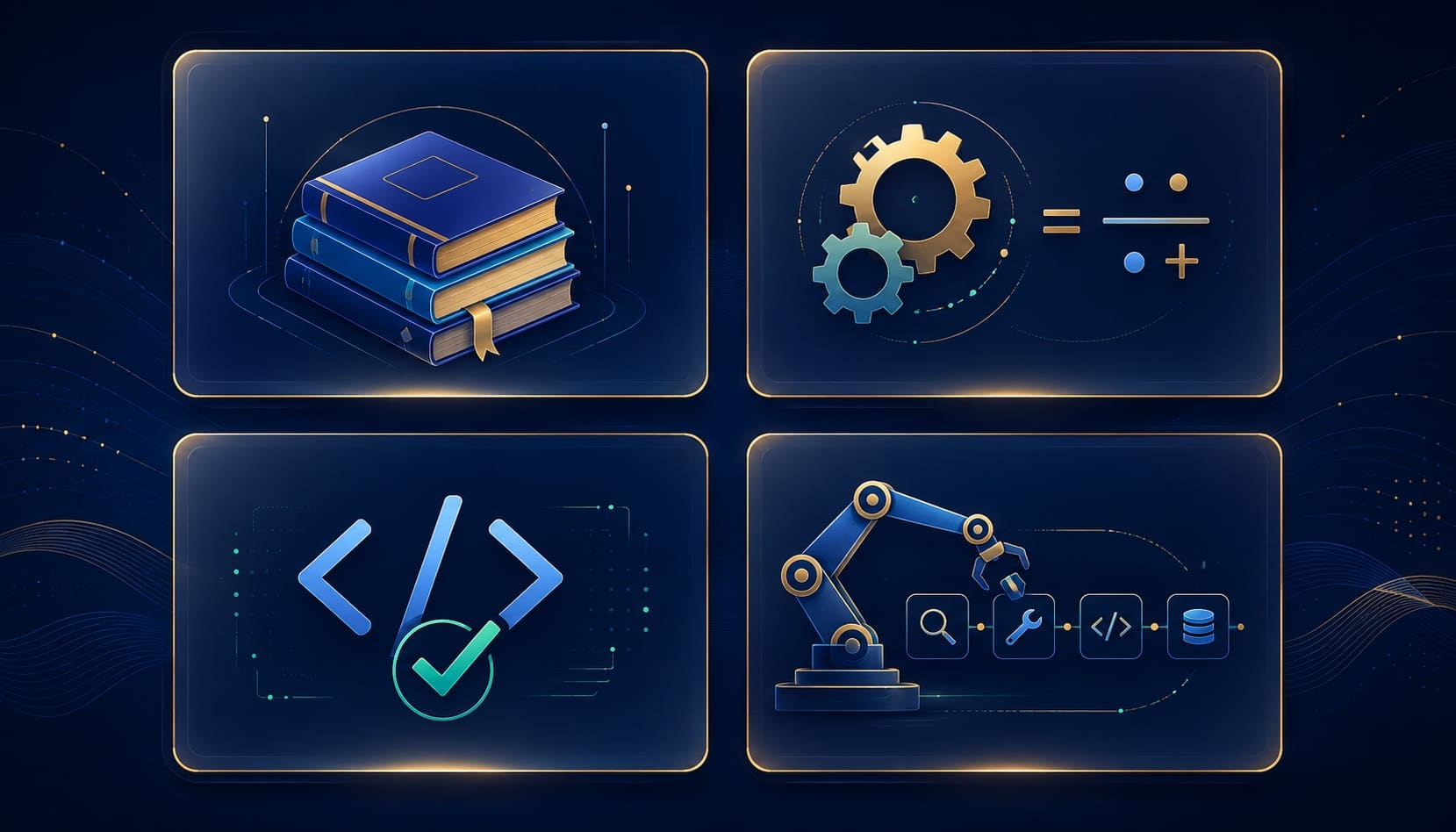
1. Knowledge and language understanding
Tests whether the model has absorbed broad factual knowledge and can reason over it in natural language. The classics: MMLU (57 academic subjects, multiple choice), MMLU-Pro (a harder, less-saturated successor), HellaSwag (commonsense completion), and TruthfulQA (factual reliability under adversarial prompts).
2. Reasoning and mathematics
Measures multi-step logical and quantitative reasoning. The benchmarks that matter in 2026: GSM8K (grade-school maths), MATH and AIME (competition-level mathematics), GPQA Diamond (PhD-level science), BIG-Bench Hard, and the new FrontierMath — a research-grade benchmark designed to remain unsaturated for years.
3. Code generation
Evaluates the model's ability to write, complete and reason about code. The progression: HumanEval (164 hand-written Python problems, now saturated), MBPP, LiveCodeBench (continuously refreshed to avoid contamination), and the agentic frontier: SWE-bench Verified and SWE-bench Pro — both based on real GitHub issues that the model must resolve end-to-end.
4. Agentic and tool-use
The newest and most enterprise-relevant family. Measures whether a model can plan, invoke tools, navigate environments and recover from failure. The leaders: OSWorld (real desktop tasks across Linux apps), MCP-Atlas (tool-calling via the Model Context Protocol), BrowseComp (autonomous web research), and τ-bench (multi-turn customer support agents). For Malaysian enterprises looking at agentic AI in production, these are the benchmarks that actually predict outcome quality.
How a benchmark score is actually calculated
"Claude Opus 4.7 scores 64.3% on SWE-bench Pro" is a sentence that hides a lot. The percentage is the output of a specific scoring protocol, and the protocol matters more than the headline number.

Accuracy and exact match — for closed-form questions
The simplest mechanic. The model produces an answer; it either matches the ground truth or it does not. Used for MMLU, GPQA, GSM8K. Reported as a percentage of correct answers across the test set. The hidden variable is format compliance — a model that answers correctly but in the wrong format gets graded wrong, which is why every leaderboard now reports both the raw number and the "after parsing" number.
pass@k — for code generation
HumanEval, MBPP, LiveCodeBench. The model is asked to generate code k times for the same problem; the score is the fraction of problems where at least one of the k generations passes the hidden test suite. pass@1 is the strictest — single-shot, no retries. Headlines often quote pass@10 or pass@100, which look more impressive but are weaker signals of single-attempt reliability.
Resolved rate — for agentic coding
SWE-bench's innovation. The model is given a real GitHub issue plus the repository at the commit before the fix, and must produce a patch that passes the project's actual test suite. The score is the percentage of issues "resolved" — a much higher bar than pass@k because the model has to navigate a real codebase, not a self-contained problem. SWE-bench Pro raised the difficulty further by curating harder issues with hidden, held-out test cases.
Elo rating — for human-preference benchmarks
LMArena (formerly Chatbot Arena) is the dominant example. Two models answer the same prompt anonymously; a human picks the winner. Pairwise outcomes feed into an Elo rating, the same system used in chess. The result is a single ranking that captures subjective quality — fluency, helpfulness, tone — that no automated metric can measure. Elo is robust to gaming but slow to update, and it conflates capability with style preference.
Trajectory and tool-use metrics — for agents
OSWorld, MCP-Atlas, τ-bench. The model is dropped into an environment, given a goal, and graded on whether the final state matches the target — plus how efficiently it got there (tool calls, tokens, wall-clock time). Some benchmarks add a safety score that penalises destructive intermediate actions even if the final state is correct. This is the only family of benchmarks that meaningfully predicts production agent behaviour.
The benchmarks that reshaped the field in 2025-26
Three forces drove the wave of new benchmarks released in late 2025 and early 2026: saturation of the classics (MMLU, HumanEval, GSM8K all clustered above 90% across flagships), contamination (training data started absorbing public test sets), and the rise of agentic workloads that older benchmarks were never designed to measure.

Humanity's Last Exam (HLE)
Released by the Center for AI Safety and Scale AI in early 2025. Three thousand questions across mathematics, the humanities and the natural sciences, contributed by domain experts and held privately to prevent training-data leakage. Frontier models scored under 10% at launch — by April 2026 the leaders sit in the 20-30% range. HLE is now the headline benchmark for measuring genuine frontier capability.
ARC-AGI-2
The successor to François Chollet's original ARC-AGI benchmark, which became saturated in late 2024. ARC-AGI-2 is harder, more abstract and explicitly designed to resist memorisation — every task requires the model to infer a novel rule from a handful of examples. Where original ARC-AGI was solved at 87% by mid-2025 systems, ARC-AGI-2 still sits in the low double digits for the best public models in April 2026.
SWE-bench Pro
The hard version of SWE-bench. The original benchmark's resolved rate climbed from single digits in 2024 to the high 60s by early 2026; SWE-bench Pro reset the bar with harder issues, hidden test cases and multi-file refactors. It is now the headline benchmark for autonomous coding agents.
MCP-Atlas
A 2025 benchmark for tool-calling via the Model Context Protocol — the open standard popularised by Anthropic and adopted across the major SDKs. Measures how reliably a model can discover, select, parameterise and chain tools to complete multi-step tasks. The benchmark Symprio watches most closely when picking a model for production agent deployments.
OSWorld
Drops the model into a real Ubuntu desktop with a goal like "find the second-most expensive item in this spreadsheet and email the result to my manager". Grades the final desktop state. Single best proxy for "computer-use agent" quality, and the benchmark behind every screen-control product launched in 2026.
FrontierMath
A privately-held set of research-grade mathematics problems, contributed by professional mathematicians, that even the best 2026 models solve at low single-digit rates. FrontierMath is deliberately designed to remain unsaturated for years — a counterweight to the gradient of benchmark inflation.
Where AI evaluation is heading

From static datasets to dynamic and adversarial evaluation
The next generation of benchmarks is not a fixed CSV. LiveBench refreshes its questions monthly. LMArena is by construction continuously updated. Adversarial benchmarks pit one model against another to surface weaknesses no static test could find. Static evaluation is becoming a baseline; dynamic evaluation is becoming the differentiator.
From capability to safety, robustness and cost
A 2026 leaderboard worth reading reports more than accuracy. It reports cost per resolved task, latency at the 95th percentile, refusal and over-refusal rates, hallucination scores under adversarial prompts, and jailbreak resistance. For enterprise procurement, these auxiliary metrics often matter more than the raw capability number.
From public benchmarks to private, workload-specific evaluation
This is the shift that matters most for Malaysian enterprises. Public benchmarks tell you which model has the highest ceiling — but they do not tell you which model wins on your workload. Every serious enterprise AI deployment in 2026 ships with a private evaluation harness: a held-out set of real customer transactions, real claims, real banking documents, scored by your own ground truth.
This is non-negotiable for regulated Malaysian sectors. BNM RMiT's expectations around AI risk management implicitly require evidence that the model performs on Malaysian-context data. PDPA-aligned data handling means the evaluation set lives inside your own infrastructure. A public MMLU score is not evidence that the model handles Bahasa Malaysia bank statements correctly.

Sovereign and regulator-aligned benchmarks
The next frontier — already visible in jurisdictions like the EU and Singapore — is regulator-published benchmarks that test for bias, harmful content, factual reliability and data-handling compliance specific to that market. Malaysia's regulatory bodies are watching this space closely; we expect BNM- and PDPA-aligned evaluation guidance to follow within the next 12-24 months. Enterprises that already run private evaluation harnesses will absorb that guidance with minimal rework. Those that do not will scramble.
What this means for Malaysian enterprises
Three takeaways for any leadership team making AI procurement or deployment decisions in 2026:
- Read benchmarks as directional, not definitive. A flagship model that leads on MMLU may still be the wrong choice for your specific workload. Use public benchmarks to shortlist; use private evaluation to choose.
- Match the benchmark to the workload. A coding-agent benchmark is not relevant to a customer-service deployment. An accuracy benchmark is not relevant to an agentic workload. The four-family taxonomy above is the single fastest filter.
- Build a private evaluation harness from day one. Every production AI workload Symprio operates ships with a held-out test set in the customer's own environment, scored on accuracy, safety, latency and cost. This is the discipline that turns a vendor pitch into measurable enterprise value — and it is the discipline that will satisfy BNM, PDPA and the regulator-aligned benchmarks coming next.
Public benchmarks are the map. Your own evaluation harness is the territory. Both matter — the mistake is using the map and pretending you have walked the ground.
Symprio designs and operates evaluation harnesses for production AI workloads across Malaysian banking, insurance, fintech and shared services — covering model selection, agentic AI evaluation, BNM RMiT and PDPA alignment. Book a 30-minute evaluation review with our team, or explore our Agentic AI practice to see how we benchmark on customer data, not vendor leaderboards.
Imagery via Pexels, used under the Pexels Free License.