Why agentic AI is the new floor for enterprise automation — and where UiPath fits.
A team that's spent five years building RPA. Three hundred bots. Reconciliation, posting, document routing, all running with the quiet precision of a Swiss watch. The CIO is proud. The COO is proud. The board approved another budget last quarter.
And yet.
The next process on the backlog is a motor insurance claims intake — free-text descriptions, photographs of damaged cars, policy lookups, judgment calls about severity. Their existing bots can't touch it. The team has been talking about it for eight months.
This is the moment thousands of enterprises are in right now. The easy 30% of automation is done. The hard 70% — work that requires reading the room, weighing options, deciding — sits there, untouched, expensive.
Until 2026, there wasn't a good answer.
Now there is.
The Ceiling
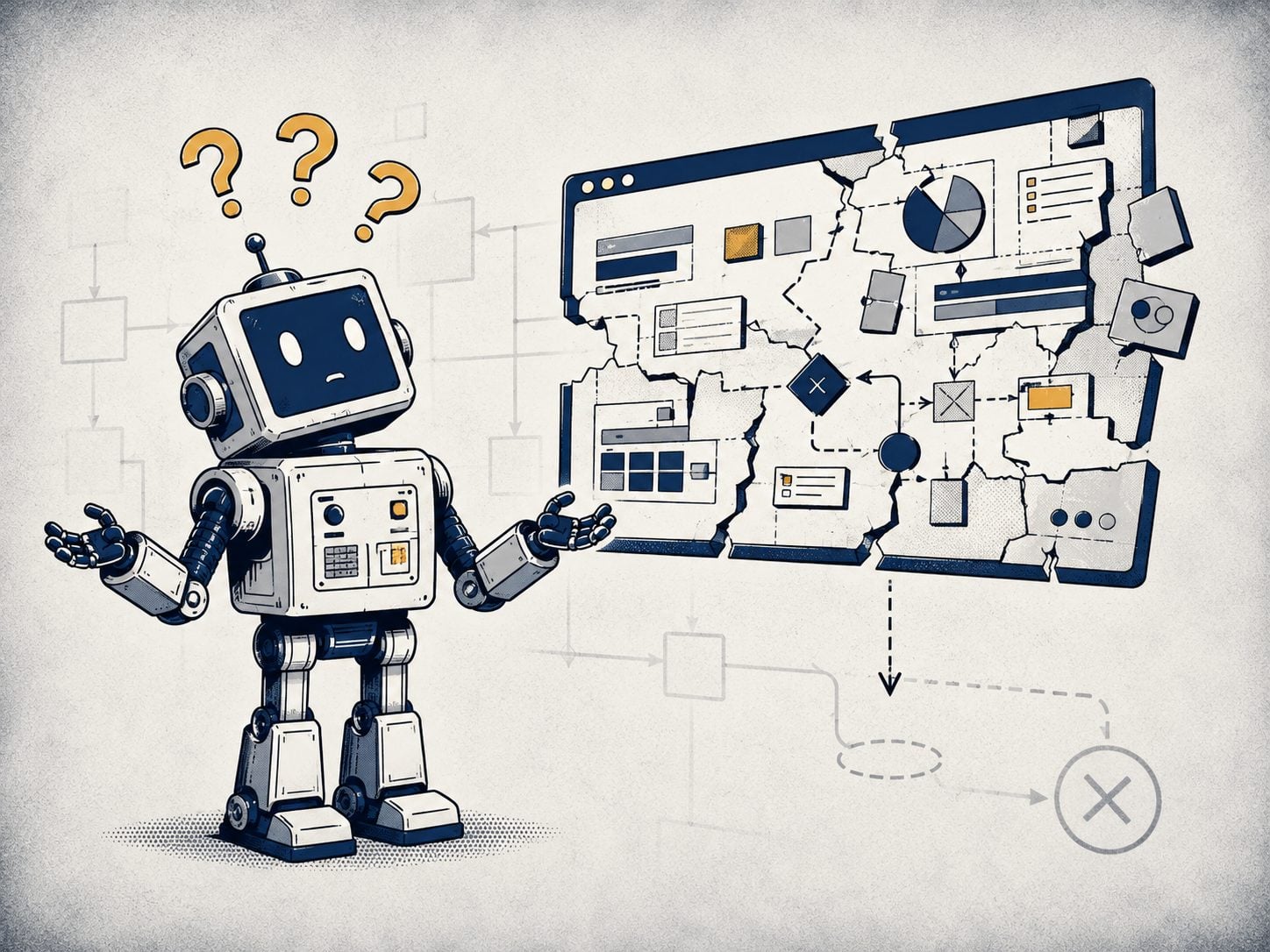
Rule-based RPA has a ceiling. It always did.
RPA shines when work is structured and repeatable. Invoice posting. Data migration. Report generation. Move data from System A to System B, every Tuesday at 9 AM, no surprises. For those processes, the ROI was undeniable, and the category produced winners like UiPath that built generational businesses.
But most enterprise work isn't like that.
Most work is ambiguous. An invoice arrives in an unexpected format. A claim has missing fields. A customer's email asks two questions and complains about a third. Every branch needs to be anticipated. Every edge case that wasn't, breaks the bot.
Forrester's data is direct: most RPA programmes plateau before they reach the scale their business cases projected. Not because RPA failed — but because the next process on the queue stopped fitting the model. (Source: Forrester, The State of Enterprise Automation 2025)
The other 70–80% of enterprise work was always out of reach. It still is, for rule-based bots.
That's the gap agentic AI fills.
Enter the Agent
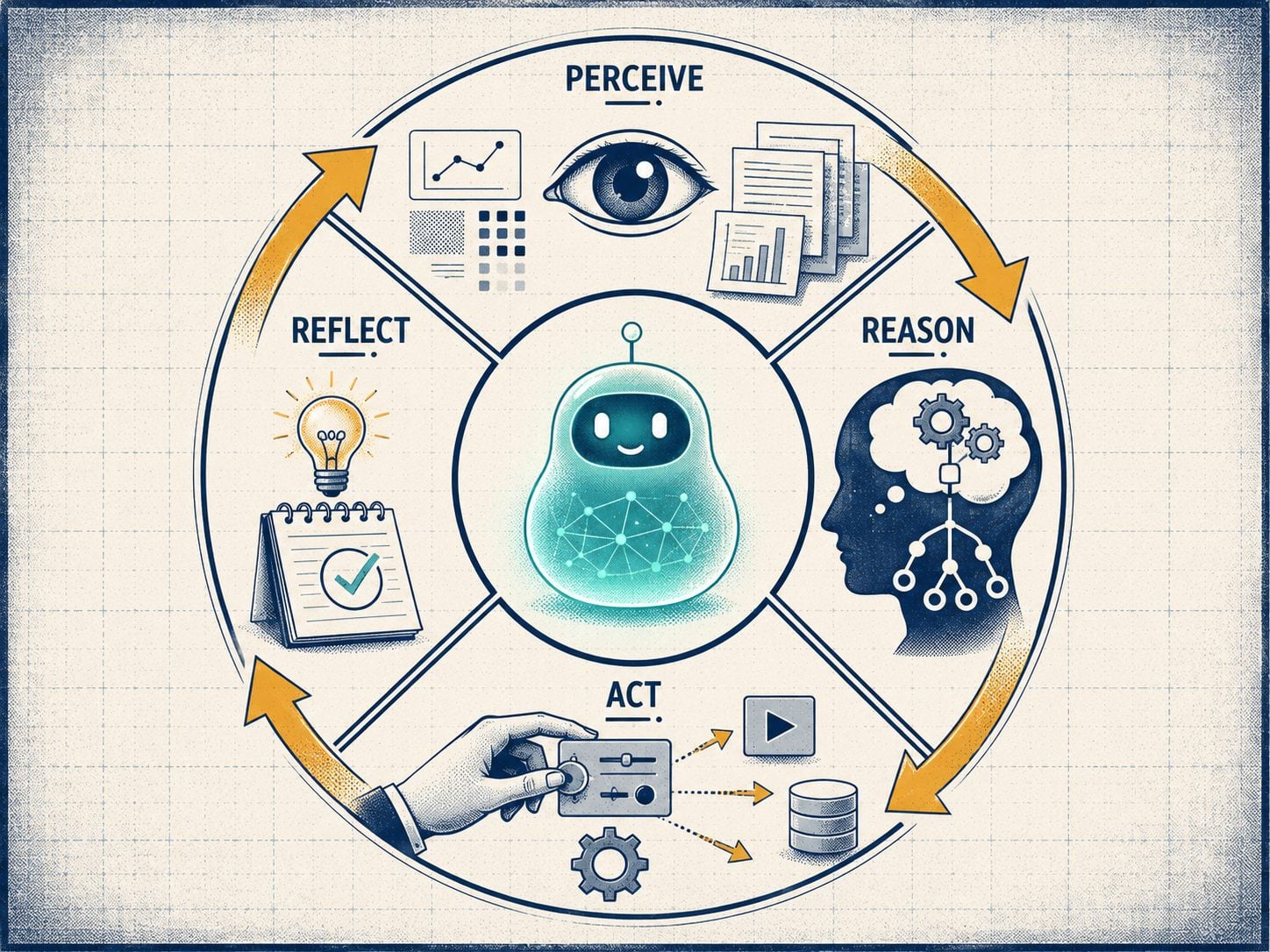
The clearest way to understand the shift: bots followed scripts. Agents read the room.
An RPA bot does what you told it to do, exactly. Click here. Read that field. Paste it there. Submit. If the screen looks different, it doesn't know what to do.
An AI agent does what you asked it to accomplish. Process this claim. Onboard this customer. Resolve this ticket. The agent figures out the steps. If something unexpected appears, it adapts. If it needs information, it goes and gets it. If it's not sure, it asks.
Under the hood, agents operate in a loop:
Perceive what's in front of them — documents, screens, conversations, data.
Reason about what to do next, given the goal.
Act through tools, APIs, robots, or by asking a human.
Reflect on what happened, and adjust.
Repeat. That loop is what makes an agent feel like a colleague rather than a script.
The capabilities that make it possible — large language models, planning models, retrieval, memory, tool use — have been advancing for years. What changed in 2025 and 2026 is that the platforms grew up around them. The capabilities are now production-grade, not lab experiments. (Source: UiPath, What is Agentic AI?)
Why 2026 Matters
Three forces converged.
The market moved. Gartner forecasts that 33% of enterprise software applications will include agentic AI by 2028, up from less than 1% in 2024. That's not a tail risk. That's the trajectory of the entire stack. (Source: Gartner, Top Strategic Predictions for 2026 and Beyond)
Customers benchmarked everything against AI. A seven-day claims process feels broken when ChatGPT answers in seconds. An onboarding flow that needs three forms feels broken when an agent could parse them all. Customer expectations don't reset to where they were before AI existed.
Competitors started shipping. McKinsey's most recent analysis shows the EBIT gap widening between enterprises that have redesigned workflows around AI and those that have bolted AI features onto legacy processes. The former are winning. The latter are paying more for less. (Source: McKinsey, The State of AI in 2025)
For an enterprise sitting on five years of RPA discipline, this is the best possible position to move from. The audit trails, the integration patterns, the governance controls — they were built for RPA, but they're exactly the foundation agentic AI needs.
For everyone else, building the agentic layer without that foundation underneath is a harder lift on two fronts.
Think, Do, Govern, Lead

A common mistake: assuming agentic AI replaces RPA.
It doesn't. They're layered.
The right way to think about it is as a four-part stack:
Agents think. They interpret context, reason about goals, plan actions, decide what to do next.
Robots do. They execute deterministic, structured actions — clicking through legacy systems, calling APIs, moving data at speed and scale. Robots are still the most reliable way to perform consistent work, especially where APIs don't exist.
Orchestration governs. It coordinates agents, robots, and people across a workflow. Who can do what. In what order. With what permissions. When does a human step in.
People lead. They set direction, approve exceptions, exercise judgment. Human-in-the-loop isn't a fallback — it's a deliberate design choice.
Each layer is irreducible. An agent without robots can't reliably execute in legacy systems. Robots without agents can't handle ambiguity. Agents and robots without orchestration become a governance problem at scale. Any of these without humans is a regulatory risk in most industries.
Enterprises that adopt agentic AI without the orchestration layer learn this within a year, usually expensively.
Why Platform Matters
The agentic AI space is crowded.
Open-source agent frameworks (LangGraph, AutoGen, CrewAI). Hyperscaler agent platforms (AWS Bedrock Agents, Azure AI Foundry, Google ADK). The major automation vendors (Automation Anywhere, Microsoft Power Automate, Blue Prism). Each does something well.
But most of them are missing pieces.
A pure-play agent framework can build a clever prototype. It can't, on its own, give you the governance, integration depth, testing infrastructure, audit trails, and human-in-the-loop tooling you need for a regulated-industry production system. Those things have to be built around it.
Enterprises don't have time to build all that themselves. Especially in BFSI, where the regulator doesn't wait for your governance framework to catch up to your prototype.
What you want is a platform that has all of it. Agents, robots, orchestration, testing, observability, human checkpoints — designed to work together, with the audit and security infrastructure baked in.
That's where UiPath comes in.
Why UiPath
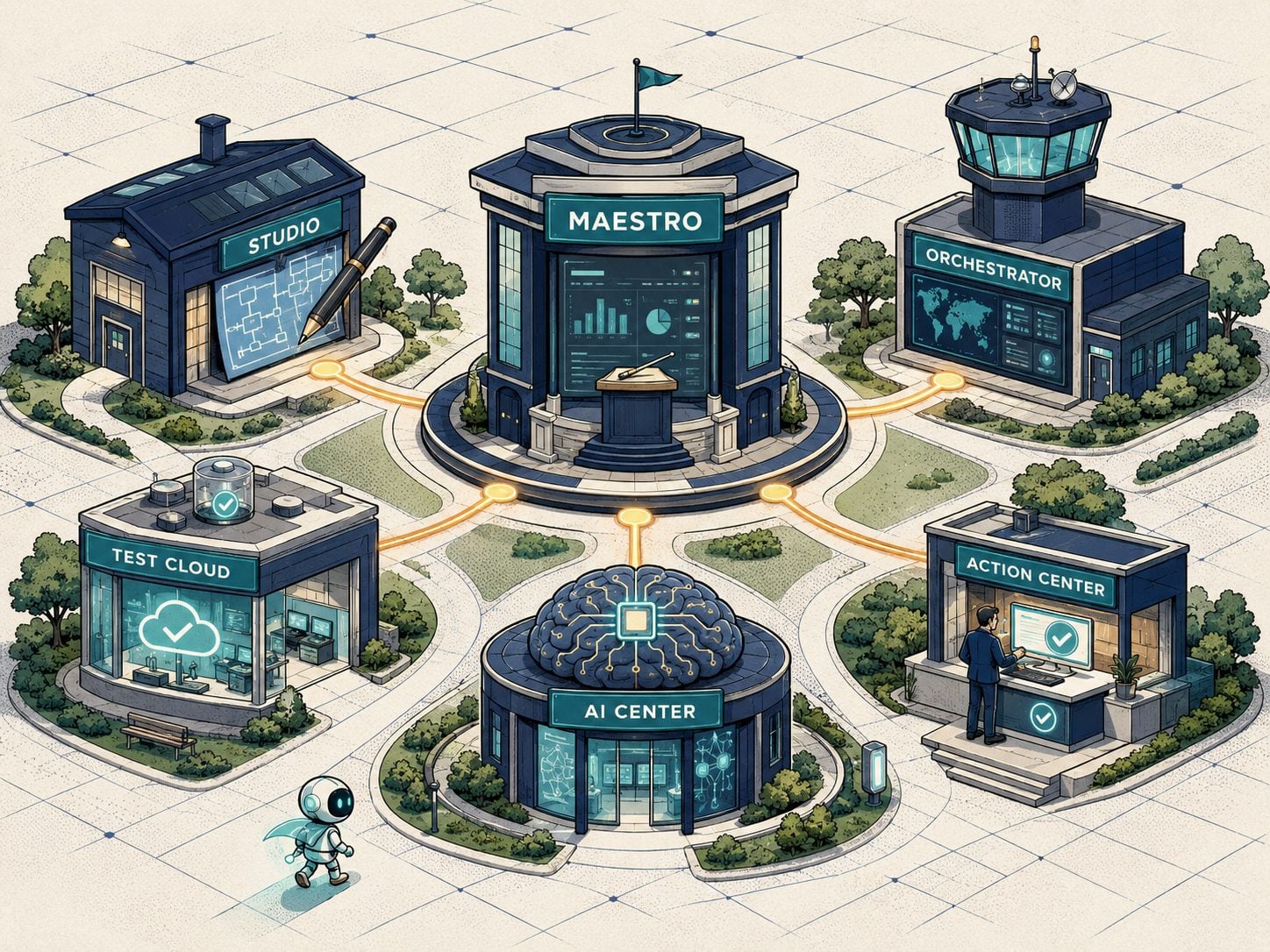
UiPath has the largest installed base of enterprise robots in the world. Millions of bots in production. Most of the regulated industries you care about are already running on it.
That base is the foundation. The agentic layer is built on top of it.
Maestro is UiPath's orchestration engine for agentic workflows. Multiple agents, multiple robots, multiple humans, all coordinated across one workflow with full audit trails and policy enforcement. Maestro is the layer that turns a clever agent prototype into a regulated-industry production system. (Source: UiPath, Agentic Orchestration with Maestro)
Studio is the unified development environment. Build agents and robots in the same tool, with the same skill set, in the same deployment pipeline. For enterprises with existing UiPath teams, no parallel hiring effort.
Coded Agents lets developers build agents in Python, with full control over reasoning logic and tool selection — while still inheriting the platform's governance and audit infrastructure. It bridges low-code automation and developer-grade agent engineering.
Test Cloud handles agentic testing. Non-deterministic systems need non-traditional QA. Gartner named UiPath a Leader in its 2025 Magic Quadrant for AI-Augmented Software Testing Tools. (Source: Gartner Magic Quadrant 2025)
Action Center provides human-in-the-loop infrastructure. Real exception approval workflows. SLA tracking. Role-based routing. Auditable.
Prebuilt agentic solutions ship for high-volume industry workflows — insurance claims, KYC, underwriting, customer service triage. Accelerates adoption for enterprises that prefer a tested baseline over building from scratch.
It's not the only platform that could do this. It's the most complete one that does do this, today, at enterprise scale.
Where Symprio Fits

Symprio is a UiPath partner with deep BFSI and enterprise automation experience across Malaysia and Southeast Asia. We build agentic workflows on UiPath, with three working principles.
Agentic AI is most valuable when layered on top of existing automation. Mature UiPath programmes can deploy production-grade agentic workflows in weeks. Enterprises without that foundation usually need a parallel stream of work to build the foundation first.
The process matters more than the model. A well-scoped agentic workflow on a high-volume, judgment-heavy process produces visible ROI within a quarter. A clever agent on the wrong process produces a slide deck.
Capability transfer is non-negotiable. Every engagement ends with a working workflow, a trained client team, and documented runbooks. We don't build dependency. We transfer capability.
That's the playbook. The clients we work with own what we build, run it themselves, and extend it without us.
The Choice
Back to the operations floor.
Five years of RPA. Three hundred bots. The motor claims intake still sitting on the backlog.
The choice isn't whether to add agentic AI. It's how quickly, on what platform, and with what partner.
The enterprises that move first — that capture the long tail of work their RPA programmes couldn't reach — will operate with a different cost structure and a different customer experience than the ones that wait. Five years from now, the two groups will be unrecognisably different.
This is the part of automation's second decade where the work gets interesting.
Working with Symprio
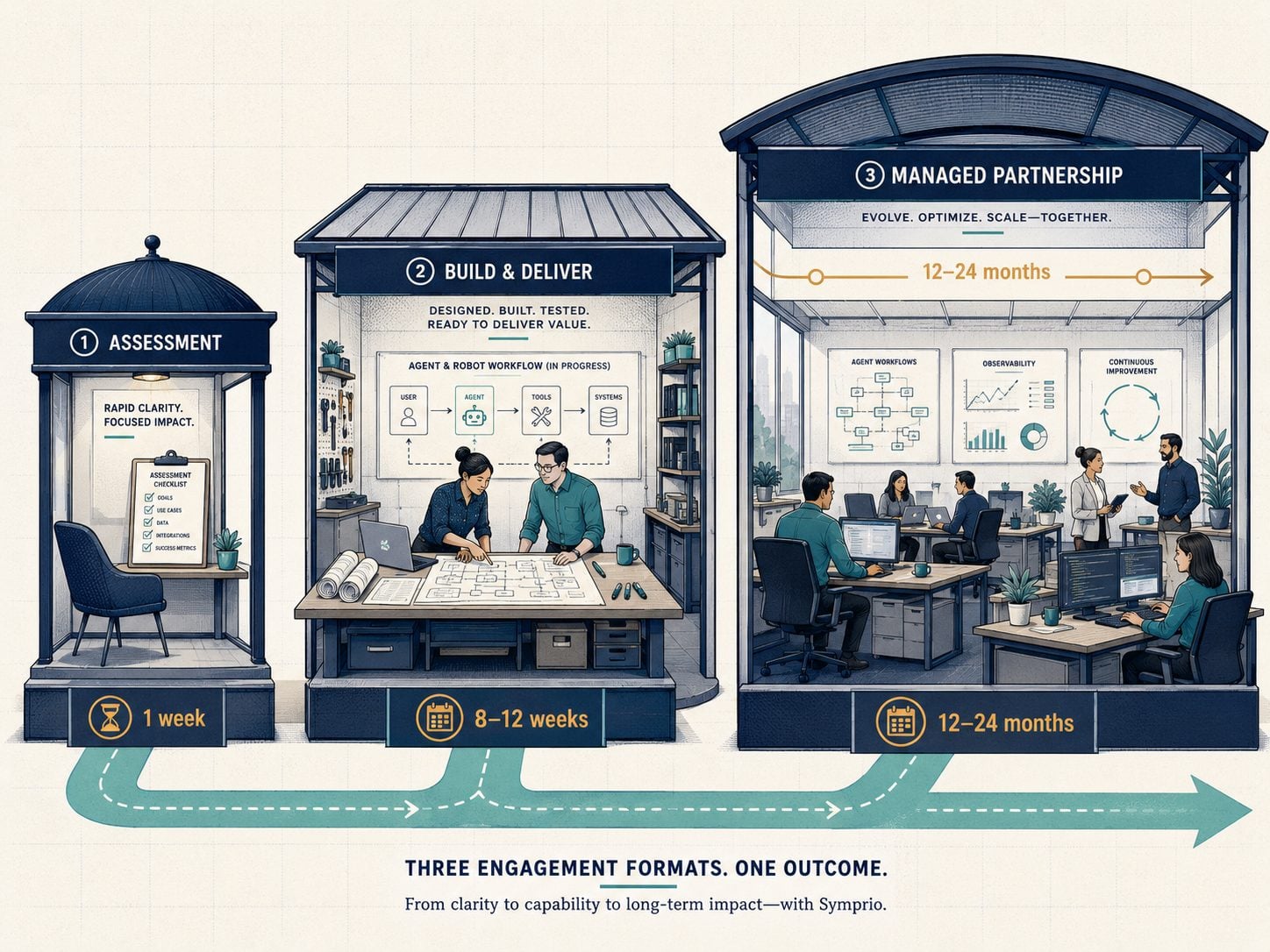
Three engagement formats:
Agentic Readiness Assessment (one week, complimentary). A working review of your existing automation portfolio and process universe. Output: a prioritised list of the three to five highest-leverage agentic workflows for your enterprise.
Pilot Agentic Workflow (8–12 weeks). Co-build a production-grade agentic workflow end-to-end on UiPath. Architecture transfer, governance setup, testing, team enablement.
Long-Term Agentic Partnership. Embedded engineering capacity to build a portfolio of agentic workflows over 12–24 months, alongside your in-house team.
Sources
UiPath — What is Agentic AI? (2026). uipath.com
UiPath — Agentic Orchestration with Maestro (2026). uipath.com
Gartner — Top Strategic Predictions for 2026 and Beyond (December 2025). gartner.com
McKinsey — The State of AI in 2025: Agents, innovation, and transformation (November 2025). mckinsey.com
Forrester — The State of Enterprise Automation 2025 (October 2025). forrester.com
Gartner — Magic Quadrant for AI-Augmented Software Testing Tools (2025). gartner.com
© Symprio. Enterprise automation, built for the agentic era. Co-built with your team. Owned by you.